It’s the season of Yangmei (Chinese Bayberry).
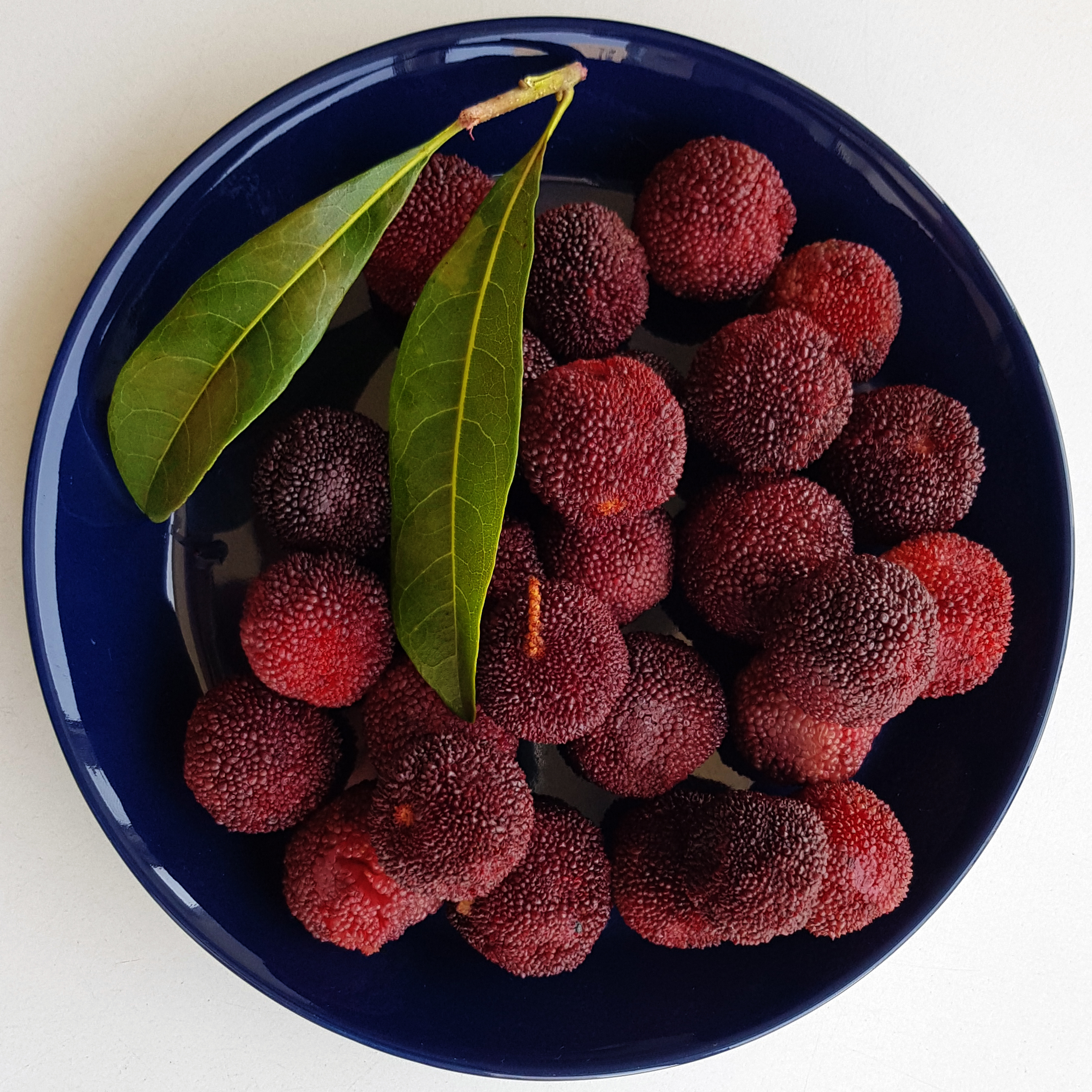
Source: Wikipedia
Yangmei (Chinese bayberry) is a near-impossible fruit to move. It almost doesn’t have a skin. At room temperature, fruit rots in 2–3 days; plain cold storage at 0–2°C and 85–90% humidity buys only 9–10d. The full preservation toolkit known to the industry — pre-harvest calcium chloride sprays, a permitted 20–30 second dip in CaCl₂ / salicylic acid / sorbic acid, modified-atmosphere packaging with 12–15% CO₂, end-to-end cold-chain trucking — pushes shelf life to roughly two weeks, and only if every link holds. Worse, ripening peaks from late May through June, which is the rainy season in southern China. Humidity is the enemy. Mold is the killer.
Yangmei’s production is not industrial agriculture. In Zhangzhou’s Longhai District — the country’s second-largest production zone — roughly 40,000 mu (666.67m^2^) of yangmei in Fugong town alone produce ~50,000 tons. Some 40,000–50,000 people work the industry, organized as 234 cooperatives, 135 family farms, and tens of thousands of unaffiliated smallholders selling into a fluid web of fixed and itinerant buying stations. Here fruits hit the cold chain and get shipped to the main consumption markets — the Yangtze Delta and Shanghai 500 to 2,000 km away.
In mid-May 2026, undercover footage from buying stations in Fugong and Baishui towns showed workers dunking baskets of yangmei into tubs containing sodium dehydroacetate — a preservative banned on fresh fruit — and unlabeled sweetener compounds. Following, on May 20, Zhangzhou authorities reported five buying stations involved, 225 kg of adulterated fruit seized at the scene, 540 kg traced and recalled, 20.1 kg of illegal additives confiscated, twelve administrative cases, two criminal cases, five detentions. A 45-day enforcement campaign covering the picking-and-shipping cycle was announced.
Within 72 hours, markets across the country shut the door for Fujian yangmei. Wholesale market in Jiangxi suspended entry for all Fujian product and demanded residue certificates from every other origin. Trucks already on the road were turned back. Buyers stopped showing up. Wholesale prices from farmer to buying station fell from ¥6-7/500g to 1–2¥; the premium East-King cultivar fell from ¥20 to ¥5-6. Farmers can’t sell their product. Everything’s cooked.
People’s Daily Sharp Commentary excerpts — the writers must know some economics:
… We must rely on long-term regulatory governance and brand stewardship — the work must be done everyday.
Fujian’s Fugong yangmei and Zhejiang’s Xianju yangmei are both national geographical-flagship products built up over several hundred years. If a brand’s bottom line is breached, what suffers is an entire regional industry, and what shatters is the “rice bowl” of tens of thousands of farmers. Regulation cannot fall into the passive cycle of “expose once, rectify briefly.” Food safety must be embedded into the DNA of the brand. A regulatory net of routinized “digital traceability + random spot-checking” must be woven tightly, leaving unscrupulous merchants nowhere to hide, turning “everyone else does it” into a fantasy, and making industry self-discipline the prevailing wind.
From the standpoint of the government–market relationship, when commercial operators cannot single-handedly withstand the risk of panic-driven suspicion spreading, government departments must step up promptly to block the contagion and rebuild trust.
In moments of crisis defined by information asymmetry, the household-by-household effort of “proving one’s innocence” is pale and powerless. This is precisely when the visible hand must act — handling problems while they are small, acting early, preventing the irrational spread of panic.
References
海薪. (2023年6月17日). 杨梅贮运保鲜技术. 果蔬收贮运保鲜技术研发中心. https://mp.weixin.qq.com/s/eCSZo7IBlPBOyIZAeCszxQ
黄景鸿. (2026年5月23日). 将"泡药杨梅"危机转化为产业升级的契机 | 电讯评论. 新华每日电讯. https://mp.weixin.qq.com/s/S_Q8eAwSyxj8xueXn_gc9Q
刘雅萱, 吴剑锋. (2026年5月21日). 惩戒虽已落下,“泡药杨梅"的反思不能止步. 新华社千笔楼. https://mp.weixin.qq.com/s/ECBnSt-n9oI2qDZFibj2DA
南方都市报. (2026年5月21日). “希望大家不要一棍子打死”!“泡药杨梅"引发信任危机,真正的病灶在监管失灵. https://mp.weixin.qq.com/s/YZB-ykypLVCjkAe72y4gYA
施晶晶. (2026年5月22日). 平时不清理门户,消费者会清理掉整个行业. 南风窗. https://mp.weixin.qq.com/s/7SM9c4fnq9dCmPtdHBaO9Q
常言道. (2026年5月19日). 人民锐评:破"药水杨梅"猜疑,关键在完善自净机制. 人民锐评(人民日报社网络评论平台). https://mp.weixin.qq.com/s/6tTCLXVVMwOLl-pYPNECoQ