Professor Shleifer come over to Booth to talk in our Monday macro/intermational economic workshop. He’s so popular that we have to move to the largest classroom and it is filled.
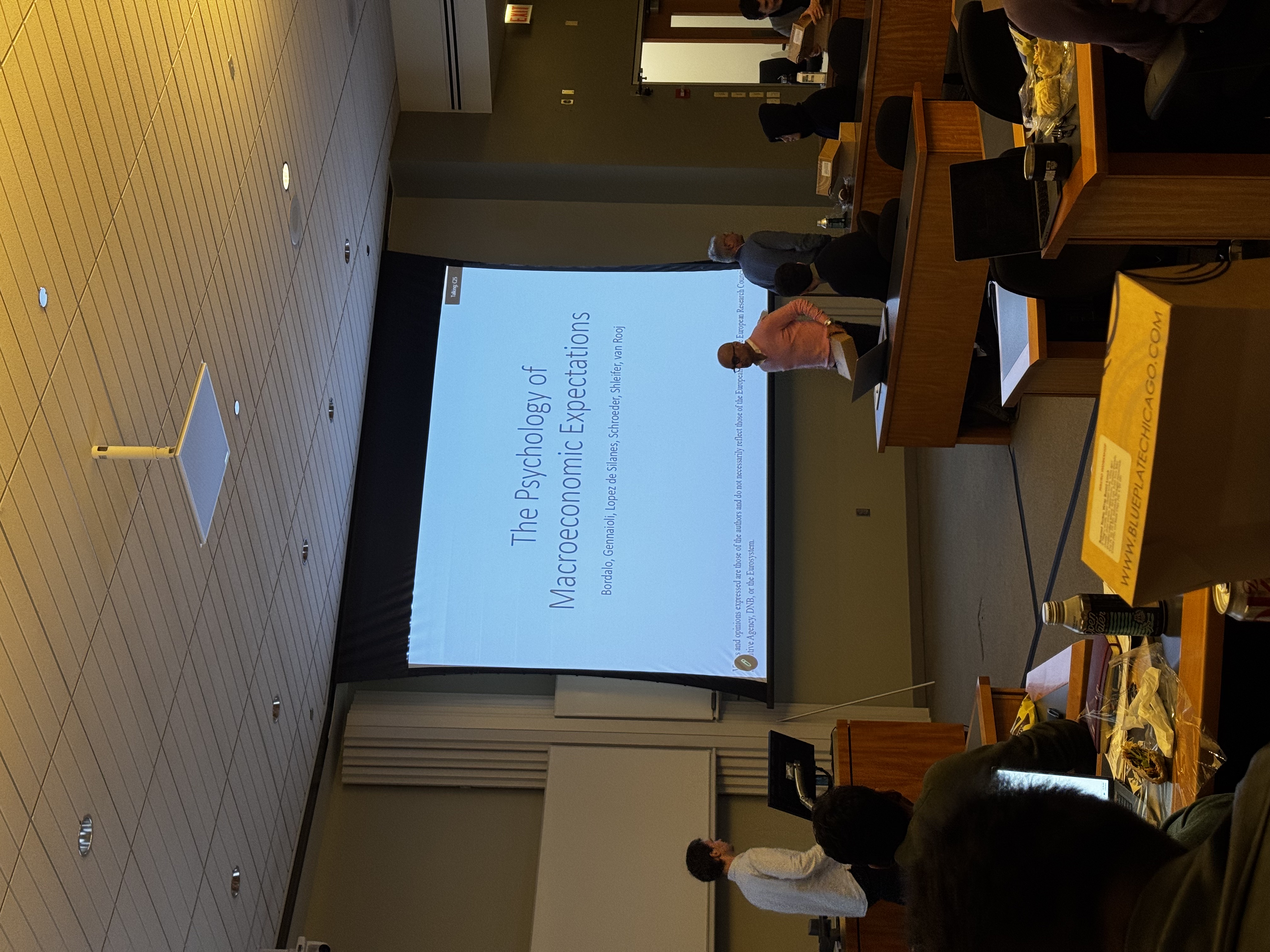
The admin bought enough sandwich for everyone though
The Psychology of Macroeconomic Expectations
Bordalo, Gennaioli, Lopez de Silanes, Schroeder, Shleifer, van Rooij (2026)
There’s a version online in Booth’s website: https://www.chicagobooth.edu/-/media/project/chicago-booth/faculty-and-insights/research-workshops/shleifer.pdf
Behavioral economics and general economic theory have left an open question in modeling: whether non-domain-specific (NDS) experiences — a health crisis, a divorce, financial hardship — could causally shift macro beliefs through a psychological, non-informational channel. This paper did the job:
The Model
The key is two cognitive primitives from psychology:
Selective Recall. Memory is a database of past experiences $e = (x, v, c)$ —
- a realization $x$
- a valence (emotional charge) $v$, and
- a context $c$.
A cue $q$ triggers retrieval via a similarity function $S(e, q)$. The probability of recalling experience $e$ is:
$$ r_e(q, \mathbf{n}) = \frac{S(e,q) \cdot n_e}{\sum_{e'} S(e',q) \cdot n_{e'}}. $$Simulation. Retrieved experiences are projected into forecasts via a simulation function $\sigma_T(e)$. Crucially, even NDS experiences can be simulated into macro forecasts if they share emotional/contextual similarity with the target. Eg. personal financial distress feels like economic hardship, so it helps you imagine high inflation — not because it’s informative, but because of associative similarity.
Beliefs = retrieval-weighted simulation across experiences. Note how it is context-dependent and manipulable by changing what’s top of mind.
$$ \mathbb{E}(\tau | q_T, \mathbf{n}) = \sum_{e \in E} r_e(q_T, \mathbf{n}) \cdot \sigma_T(e). $$The Experiment
Using 4,000+ households in the Dutch National Bank Household Survey (DHS), the authors:
- Prime treated subjects to recall a personal financial or health adversity before eliciting inflation and home-price-growth expectations.
- Measure the full cognitive pipeline: NDS experiences lived, perceived similarity of those experiences to high inflation/HPG, domain-specific backcasts, and stated reasoning for forecasts.
This design is cool and shapr in terms of identification, because priming conveys zero macro information — it only changes mental state. The finding is:
- Experience effects: Households with NDS experiences more similar to high inflation expect higher inflation — driven by similarity structure, not information.
- Instability: Primed households expect significantly higher inflation/HPG than control households who lived the same adversities but weren’t primed. Effect sizes: up to ~1 pp shift in inflation expectations (mean: 5.46%).
- Context-specificity: Financial priming produces larger effects than health priming, consistent with financial distress being more similar to inflation.
- Mechanism confirmed: Priming shifts both (i) DS backcasts (people recall more bad past inflation) and (ii) reasoning (more personal, emotionally negative narratives) — exactly as the recall + simulation model predicts.
Macro Implications
Heterogeneity: Low-social economic status individuals carry worse NDS databases (in their brain) → systematically more pessimistic → higher MPC → non-trivial allocative consequences.
Confidence Multiplier: One agent’s spending is a cue for another agent. Expansion by some → cues good macro outcomes for others → further optimism and spending → amplification loop. This provides a micro-founded mechanism for demand-driven fluctuations through belief externalities — a formal version of Keynes’s animal spirits.
I haven’t feel wowed from a talk in a while — might be the sandwich’s fault. This is a great idea and great paper!