Benjamin Grosvenor hit the CSO Sunday 3pm stage with a program that speaks different musical languages: Beethoven’s Moonlight Sonata, Schumann’s Fantasy in C Major (Op. 17), Scriabin’s Sonata No 2 (Op. 19) and Ravel’s Gaspard de la nuit.
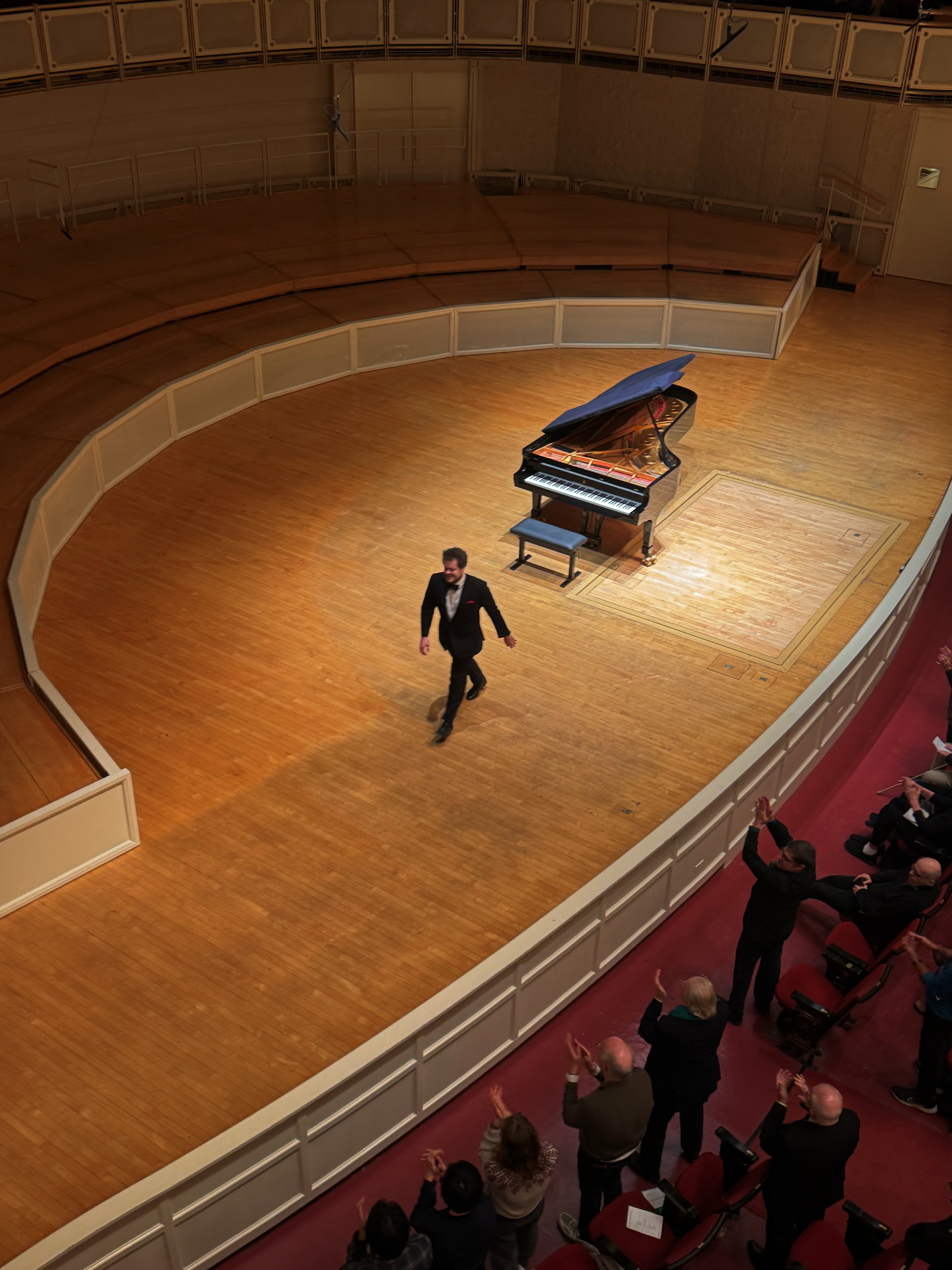
Benjamin Grosvenor plays Ravel really well. I hear the poetic vibe and surreal magic.
Though you don’t need a PhD in music to appreciate the beauty of Moonlight Sonata, and despite the program are all popular composer’s signature work — with a bit of learning, one can you hear the difference of how composers speak through music, especially with the contrasting program.
Reminds me of:
Mahler versus Stravinsky
So, is the “applied-theory” style mere fakery? Is it nothing more than putting lipstick on a pig? That is not how I think about the issue. To clarify my position, I would like to use an analogy from “classical” music, by comparing two twentieth-century composers. Gustav Mahler is known for the rhetorical intensity of his compositions, epitomizing the Romantic tradition of using musical devices to stir and mimic emotions. By contrast, Igor Stravinsky is equally well-known for his coolness of expression and his avoidance of straightforward links between musical occurrences and human emotions. Listeners will have their own preferences over the “rhetorical temperature” of their classical music.
Personally, I’m on Team Stravinsky. But this does not stop me from appreciating Mahler’s tactics and sometimes even enjoying them.
I think of the distinction between the “pure” and “applied” styles in similar terms. “Pure theory” represents " cool rhetoric," whereas “applied theory” means amping up the rhetorical devices that the paper employs to establish a tangible correspondence between model and reality. Personally, I’m on Team Pure. But this does not stop me from appreciating the devices that masters of the “applied” style use to enhance the impact of their work on their readers. Perhaps I am even envious of them, because I don’t actually know how they do it! Trying to make sense of this style is no sign of disrespect toward it. It is provocative only if we deny that these devices have anything to do with how economic theory papers are received by their readers.
Ran Spiegler, The Curious Culture of Economic Theory
Bruce Duffie: But why are these modern operas not as well-known as the Verdi operas? Why does the public always flock to Don Carlo or Aida, whereas they don’t flock to Lulu or Wozzeck?
Claudio Abbado: Well, it takes time, I should think. It’s a new language. In the meantime, Wozzeck in Vienna is as popular as a classical opera. The audiences get crazy for Wozzeck. I think it’s a masterpiece. It’s not maybe so easy to understand the first time, but Wozzeck today is classical. If someone who is Japanese or Chinese came here in this room, I would not close the door because we wouldn’t understand. That’s wrong. We have to try to understand, even if we don’t know the language. I don’t know Japanese or Chinese. I don’t know if you know these languages, but we have to try to understand if somebody asks. It’s the same with new music, which is a new language. We have to try to understand, so the best is to and listen and listen and listen many times.
Conductor Claudio Abbado A Conversation with Bruce Duffie | 1985 Bruce Duffie https://www.bruceduffie.com/abbado.html