
St Louis
I took an Amtrak to St Louis to hear their orchestra perform Scheherazade. Once the train left Chicago, it quickly entered open land, soaring through boundless fields and occasional small towns. It was a peculiar kind of freedom, with a sense of desolation and solitude.
St Louis carried the grand heritage of their 1904 world fair. But there’s no mall downtown, and I couldn’t find a csv pharmacy for toothbrush after 4pm. A short distance beyond the city lies endless farmland again.
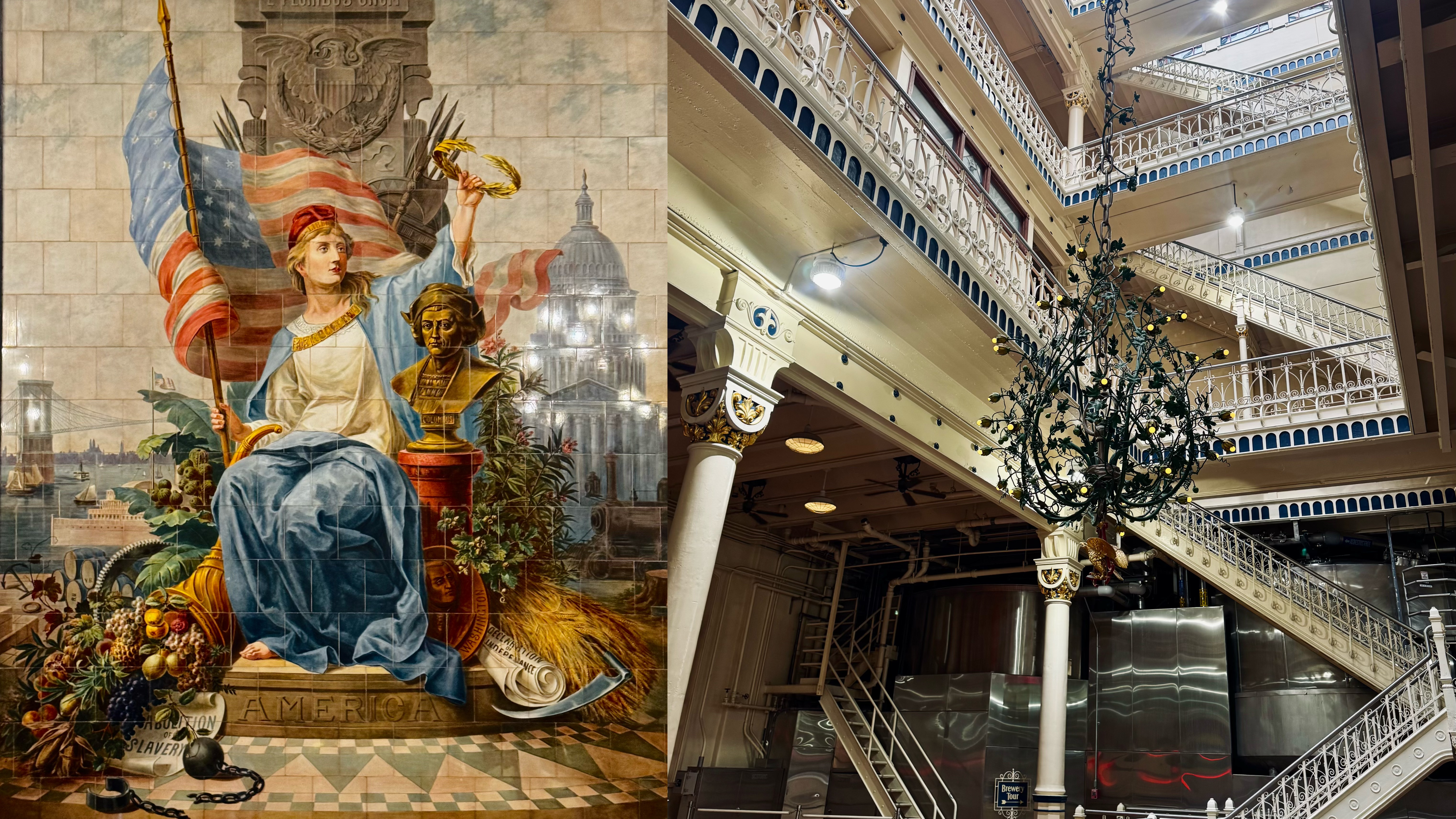
The beautiful Anheuser-Busch Brewery in the periphary of St Louis downtown — clearly, Mr Busch got the wolrd fair chandelier as a souvenir then.
This reminds me of different styles of civilization. Europe has more people and history. The cities, institutions, and arts all display a strong sense of structure. East Asian civilizations, with a lot of introspection (and even denser population), places more ethical and social responsibility that sustains stabilities. But here, grew out of vast space and continual migration, for the first time I feel boundless freedom.
It’s clear to see the constrast reflected in art. Bach and Beethoven is fundamentally beauty born out of structure and proportions. On the other hand many modern music, eg jazz, emphasize improvisation and expressionism. Same applies for paintings, literature, movies, etc. In general it is a dichotomy of two distinct forms of the sublime aesthetic. The classical beauty of order is built on proportion, structure, and formal completion. And beyond classical harmony there is another kind of beauty arising from immense forces—mountains, oceans, storms—that comes from scale and uncontrollability (Edmund Burke). A similar intuition appears in Chinese Daoism, “无为” (aka do nothing) — suggesting against excessive human interference. You see in Chinese landscape painting, where intentional asymmetry and empty space evoke a structure that grows organically rather than being strictly imposed.
And something similar appears at the level of civilizations. Different societies, born out of their respective geography and history, seemed to have found different balances between order and freedom. Latin culture (Spain, Italy, Portugal etc) offers an interesting counterfactual for thought experiment. While its deep roots lie in the legal and political traditions of the Roman Empire, the Mediterranean societies has their institutional heritage gradually merged with a vibrant culture of secular life. When this cultural tradition traveled to the Americas it produced Latin American societies—Mexico, Brazil, Argentina—where European institutional frameworks coexist with intense social vitality.
So how much structure does a civilization needs? Or how much freedom should be given to it? This is a hard question. The su proved one extreme wrong through a giant field experiment with cost of generations. Theory proved the other extreme wrong — social choice has long shown that collective decision mechanisms inevitably contain tensions. Prosperity therefore cannot arise from a perfectly designed system; it persists only through imperfect rules that maintain a dynamic balance.
And the dynamic comes from freedom.
But note that it is also important to distinguish two kinds of disorder. In nature, complexity—mountains, oceans, forests—can produce a sublime beauty because it emerges from long evolutionary processes. Social disorder that results from institutional limitations, conflicting interests, and historical contingency is not the same.
In this sense freedom itself must also be understood carefully. Traditions that emphasize freedom do not necessarily imply the absence of structure as a foundation. The market freedom described by Adam Smith, for example, presupposes a stable institutional foundation: basic law, public infrastructure, property rights, and a degree of social protection. Freedom is not the opposite of order; it depends on a certain underlying order in order to exist.
Perhaps civilization itself could one day be understood as a much larger problem of mechanism design. Economics has so far applied its tools mostly at the micro scale—markets, auctions, matching. How about extending those tools further toward the institutional architecture within which entire societies evolve? Not to engineer a perfect society, but to understand which institutional structures are most capable, over the long run, of sustaining freedom, order, and continued development of human societies.
It is an old question, and a difficult one. Civilizations have struggled with it for centuries, and there is little reason to believe we are close to resolving it. The great Russian symphonic (sort of) expose this tension with struggle, reflection, and a certain quiet consolation. Scheherazade lives on imagination, where the order motif returns night after night from suspense and uncertainty and finally ends in peace. So perhaps that uncertainty is not entirely discouraging. We have long lived with such questions, and have learned somehow to endure them — and sometimes even to find beauty within.
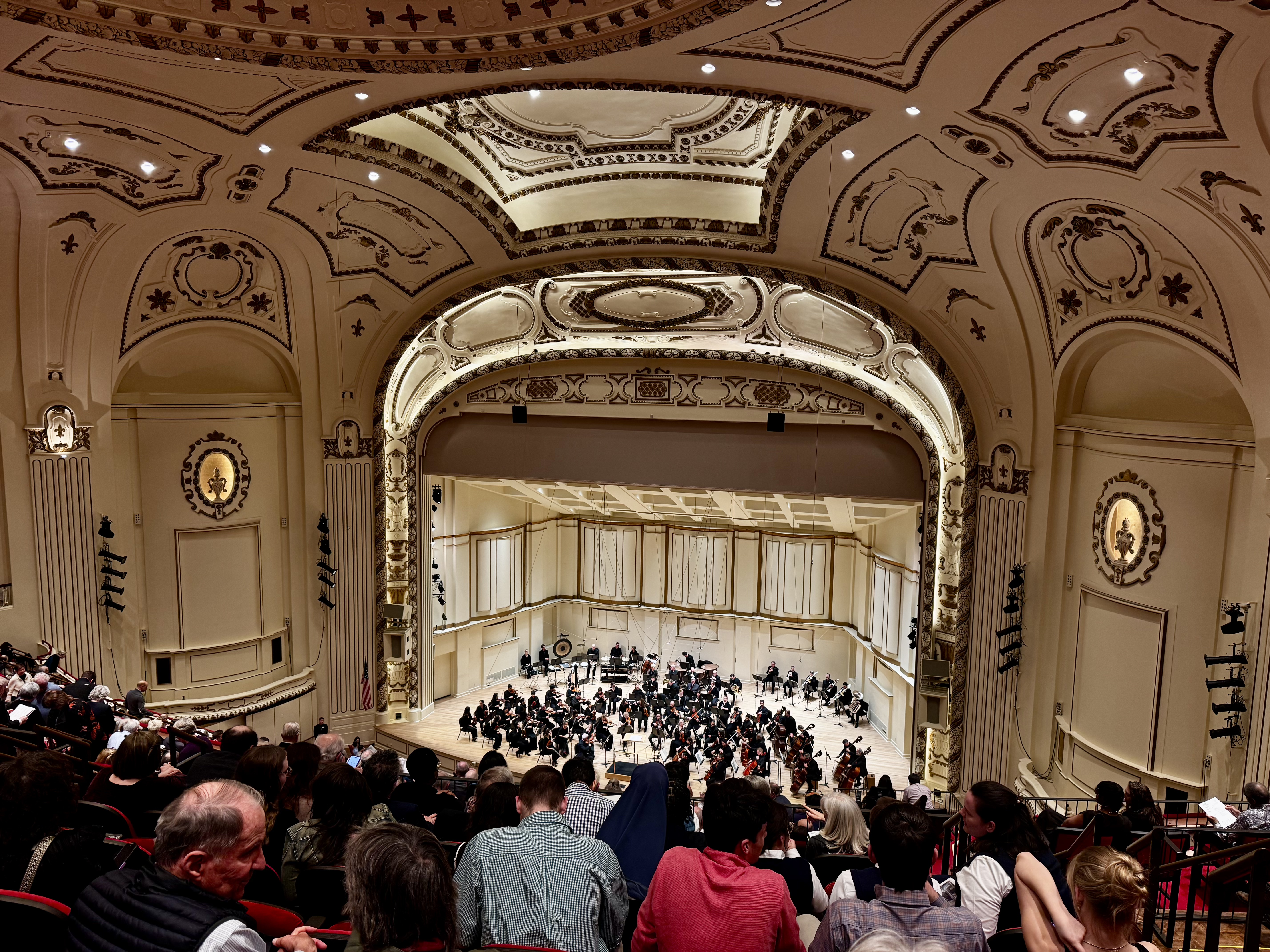
St Louis Symphony Orchestra Powell Concert Hall. The acoustic is very good.