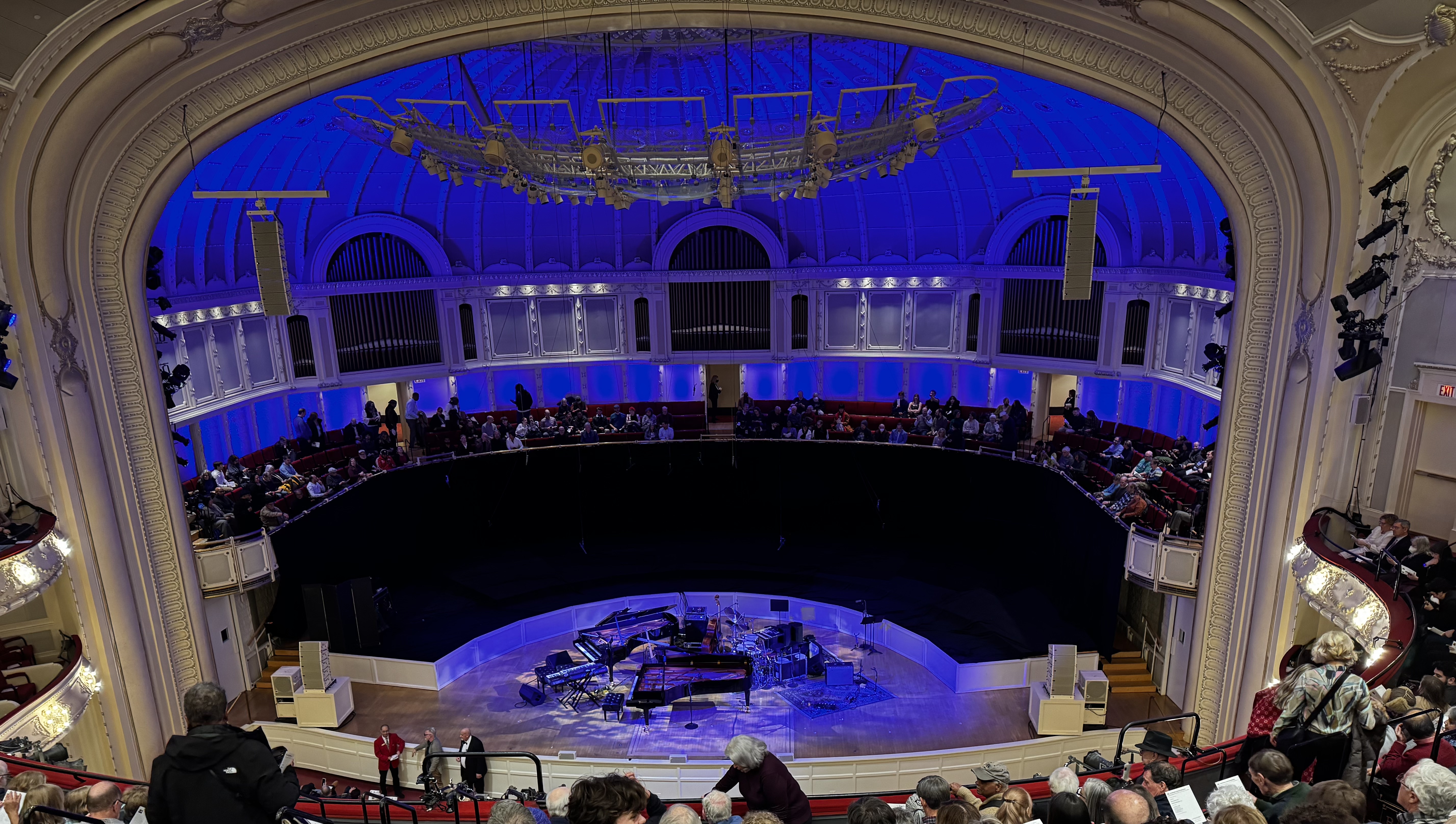
Friday night at the CSO — sans Muti, plus bourbon
Maestro Muti had taken the regulars off to Wheaton for the evening, leaving Symphony Center to do something rather brave, or rather reckless, depending on your temperament: host jazz on a Friday night. While sensible Chicagoans were settling into barstools and letting bebop wash over them with a proper Old Fashioned in hand, we — a friend visiting from New York and I — decided to experience the best Chicago has to offer. Jazz, yes. But jazz in that hall.
I should say at the outset: this was not a bad performance. I like and listen to jazz. Put preference aside, there’s never such thing as a bad or inferior genre — only bad techniques or performances that fail to deliver. And sometimes there can be a mismatch of spirit and setting, of form and content — when a music that lives to breathe but a room that asks it, very politely, to hold still.
Jazz is the art of becoming — of improvisation, defiance, and the glorious mess of self-expression finding its shape in real time. It asks the audience to lean in, to shout back, to clink glasses at the wrong moment and love every second of it. Symphony Center, magnificent as it is, asks us sit attentively, applaud at the prescribed intervals, and listen with a kind of reverent stillness that belongs to Brahms, not Bird.
And so the first half unfolded with all the technical competence one could ask for — and none of the recklessness one secretly hoped for. Improvisation, stripped of its native habitat, became something to be observed rather than felt. The audience responded in kind, offering appreciative applause that carried a faint whiff of ceremony — as though we had all collectively agreed to admire the emperor’s new cadenza. I don’t doubt the artistry on stage. I only wonder whether artistry, unmoored from the communion that jazz demands, is enough to fill a hall this large and this quiet.
It didn’t move me. And in a genre where the whole point is to be moved — where there are no scores to hide behind and no standard repertoire to cushion the fall — that silence between my ears felt like the only honest review.
Then there was the matter of the Bösendorfer.
A Bösendorfer is a philosophy — Viennese warmth, a singing bass, a tone that darkens and blooms like late afternoon light through stained glass. Wheel one onto the concert hall stage then run it through amplification is sacrilegious. Why invite that voice into the room only to smother it in a loudspeaker’s approximation of itself? It is a little like flying someone first class to Chicago, then asking them to shout the conversation through a megaphone.
The second half, mercifully, remembered what jazz is for.
A full band took the stage — an ensemble of clearly brilliant musicians who had the good sense to plan. And here lies the paradox that the evening quietly illuminated: jazz at its most free is not jazz at its most formless. The best improvisations are scaffolded by structure, by musicians who listen as fiercely as they play, by arrangements that give the spontaneous somewhere to land. In the second half, you could hear all of this — the architecture beneath the abandon, the conversation between players who trusted each other enough to take risks and catch each other mid-fall. The hall, finally, filled. Not just with sound, but with intent.
It was a reminder that freedom in music, as in life, is not the absence of constraint but the mastery of it.
Perhaps it is the deeper tension of the evening that left me turning over. Jazz has always defined itself in opposition — the rebellion is its beauty. The performer were brilliant, the hall was beautiful, but the music is a little too well-behaved tonight. A wild thing was asked to wear a tuxedo. It was still nice, but I only wished it hadn’t.