Joffrey’s winter season show the American Icons is on. It features four contemporary choreographies in one night.
- Kettentanz choreographed by Gerald Arpino, with music by Johann Strauss Sr.
- Secular Games by Martha Graham
- Exerpt from Postcards by Robert Joffrey, with music by Satie
- Voluntaries by Glen Tetley, with music by Francis Poulenc
A view into the kaleidoscope night:
The night begins with —
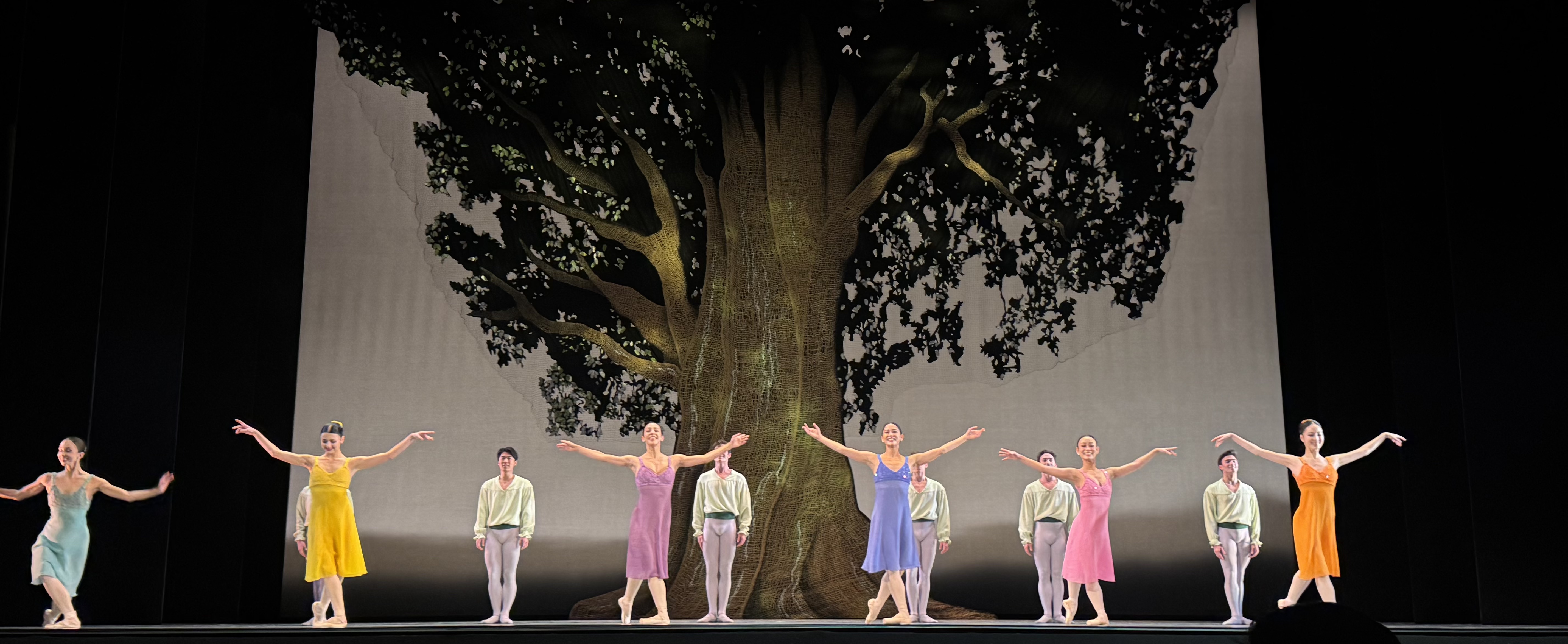
Teletubbies?
Just kidding. The Kettentanz features Strauss Sr.’s cheerful composition — straightforward, happy, a little boring. As if it’s chosen intentionally to mimic the music we hear at ballet classes (but my standard is Tchaikovsky and Chopin, so judge not the pianist not, judge me). Kettentanz’s choreography feels less like an piece intended for performance and more like an etudes — a series of Grand Allegros, with dense technique showcase and seldom thinkings. You’ll see what I mean:
But also, among the world of art where nowadays everything is supposed to have deep artistic meaning whenever possible, it’s fun and refreshing to present in such an up front, straightforward style, to show off clean technique, the varieties of steps, and remind us of the days we spent in the studios (practice rooms). Plus Joffrey’s dancers, including the corps, have solid technique to make the piece seems easy — you know the dancers did a great job when during intermission audience are attempting to do the choreography’s signature bouncing steps (e.g. at the start of the video).
Intermission
When will you hear ballet audience gasp? One case is when dancers jump into a huge fish dive at the final coda of a pas de deux (for example). Or, in tonight’s case, when Martha Graham’s Secular Games opens with the curtain rises and six male ballet dancers half naked pose on stage like greek sculptures. Like the following, but with better lighting.
Then mezzo soprano Camille Robles joined on stage to sing Satie for Postcards by Robert Joffrey. “A ballet depicting vignettes of Paris in the early 1900s, evoking fleeting relationships and whimsical memories, with challenging maneuvers and luscious classical movement.” He gives us the essence of the movie shipboard romance" (NYTimes, Ballet: The Joffrey Honors Erik Satie (1980)).
Intermission
And finally we got to the night’s star program. I find it to be immensely beautiful but don’t know how to describe it so I’m going to refer to the best review I’ve found:
The mood shifts dramatically with the final work: Glen Tetley’s “Voluntaries,” created in 1973 for the Stuttgart Ballet as a memorial for his friend John Cranko. If the rest of “American Icons” channels America’s youthful exuberance, “Voluntaries” is a move into maturity, alternately elegiac and hopeful, grappling with mortality and meaning.
“Voluntaries” begins in silence and stillness, Joffrey principals Victoria Jaiani and Dylan Gutierrez in white unitards center stage against the backdrop of a glowing orb. They move forward and, as Jaiani extends her endless leg, the first chord of Poulenc’s “Concerto for Organ, Strings and Timpani” crashes down, breaking the spell, and she is lifted, spiraling toward the sky.
With the full company on stage, the work is a perpetual motion machine, the dancers moving in unison and in canon through motifs surely grueling in their technical demands. Tetley’s choreography is classical in essence but requires the dancers to twist and contract along unexpected meridians as they breathe through the endlessly iterating arabesques and sidelong tilts of modern dance.
The men eat up the stage with liquid leaps; the women are swept into daring lifts, piking overhead, diving to their partners’ ankles, and repeatedly borne aloft in narrow X’s reminiscent of the Crucifixion — an image later made explicit as the dancers repeatedly extend their arms, birdlike, into a downturned cross.
The religious, or spiritual, overtones are clear, with the organ blasts contributing to the air of majesty. As an exploration of grief, “Voluntaries” is emotional and expansive. With a purity of movement and intent, there is nothing coy happening here, just pain, joy and transcendence. The whole evening delivers, but in the stunning hands — and legs — of the Joffrey dancers, “Voluntaries” lifts the program to the heavens.
Chicago Suntimes Review: “American Icons” showcases the exceptional melting pot that is the Joffrey and American dance
Contemporary ballet, if not more difficult than classical repertoire, are certainly not less annoying to dance, and certainly more difficult to interpret. My luck is that the principles of the Feb 20 night is Anais Bueno and Stefan Gonçalvez — one of the bests at Joffrey, they have impeccable technique and excellent artistry to touch the depth of the work.
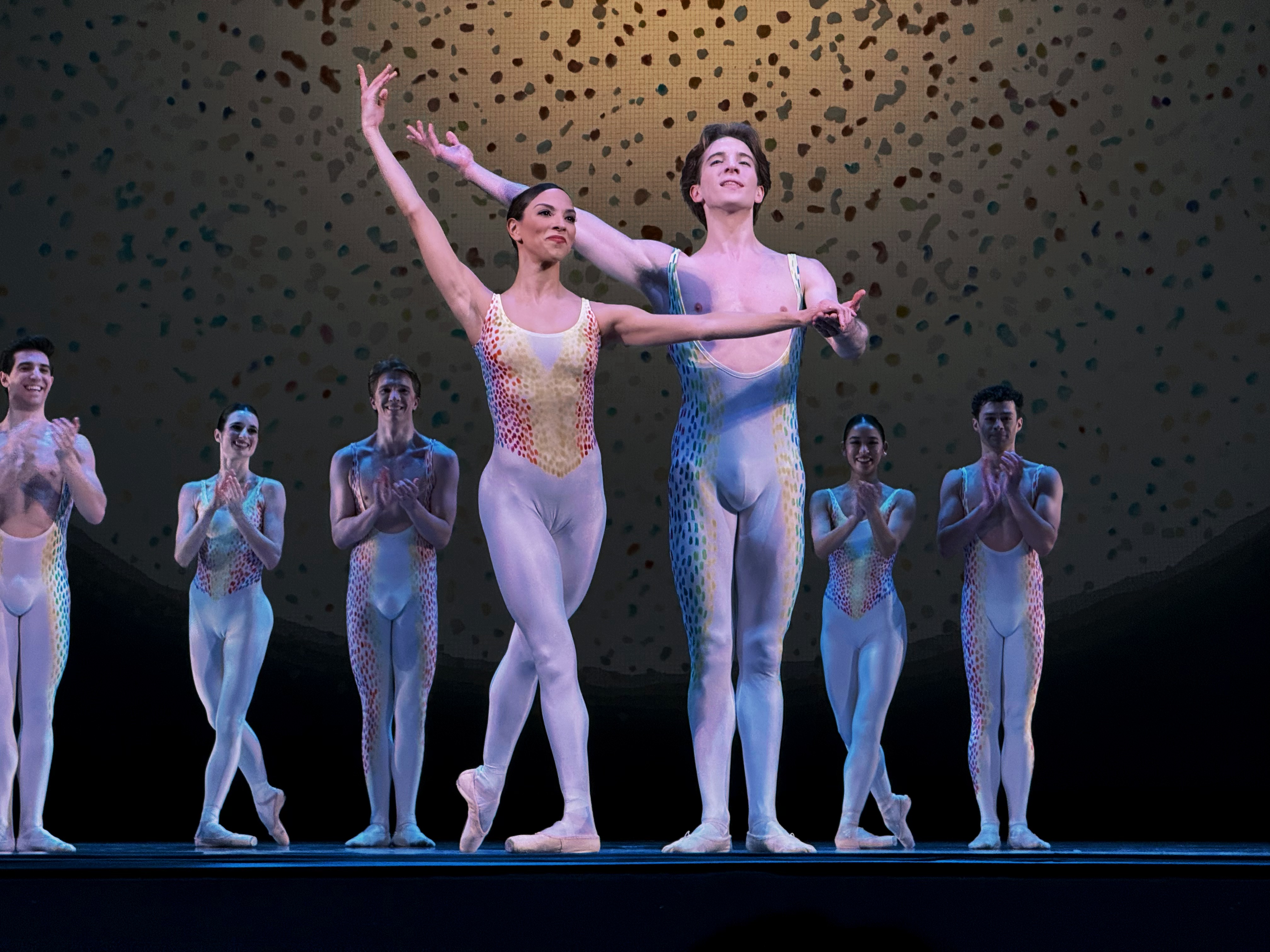
Anais Bueno is amazing. I feel lucky to be able to sit front row center to closely witness her showcasing profound artistry, astounding shape, and flawless technique.