Another lecture note from macroeconomic class.
Question: why the log GDP per capita are widely different across countries and that they doesn’t seem to converge?
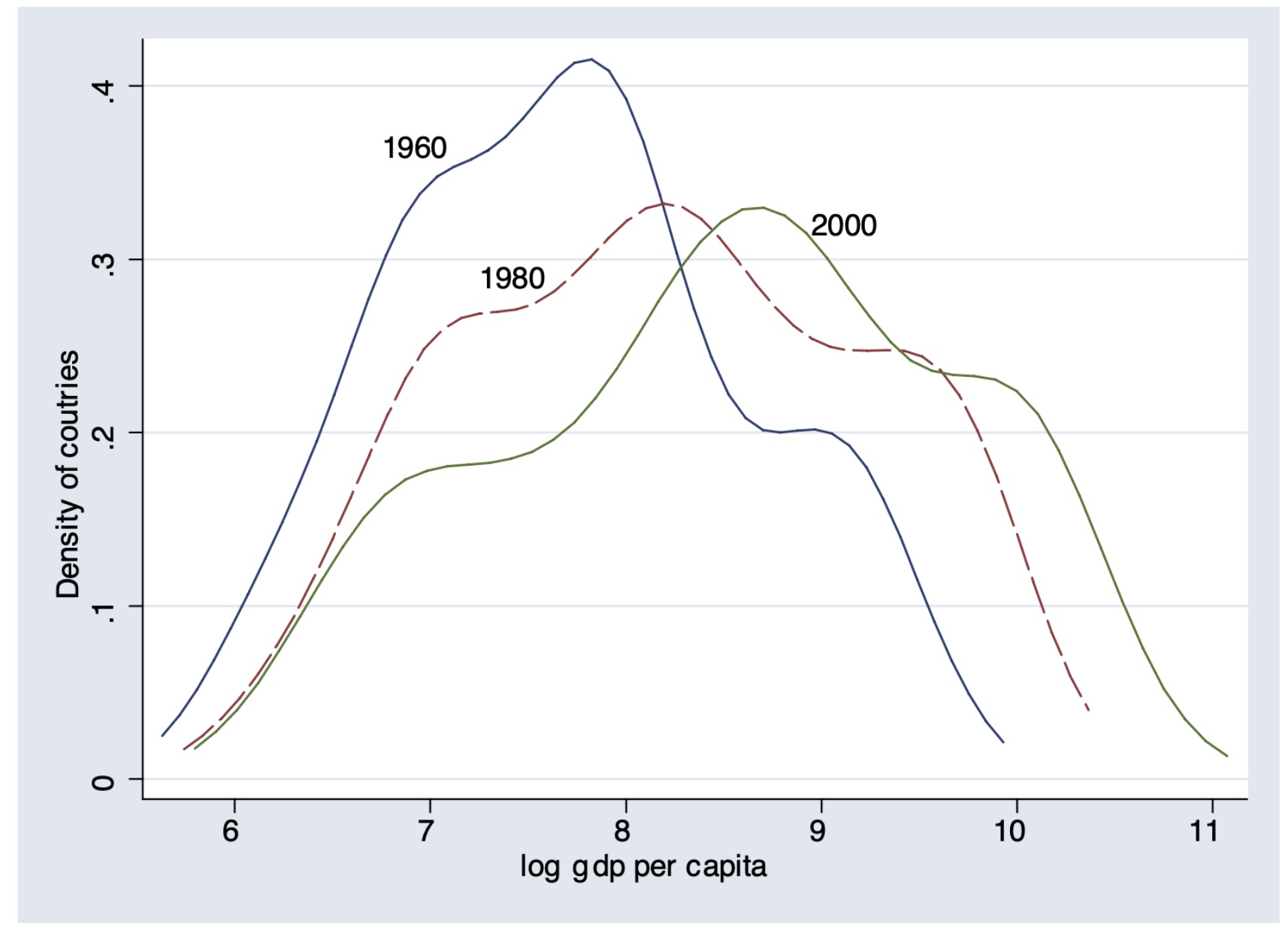
Estimates of the distribution of countries according to log GDP per capita (PPP-adjusted) in 1960, 1980 and 2000. Courtesy to Theory of Income II class.
Assuming Cobb-Douglas, data analysis says that over 60% of cross-country income dispersion is attributable to TFP differences, not input differences. Countries are not poor simply because they lack capital or education — they are poor because they use their inputs far less productively. Technology/efficiency differences ($A$) of the production function are the dominant explanation.
Misallocation Verification
Consider a static economy with two sectors $i\in \lbrace M, A\rbrace$ (agriculture and manufacturing) both with CRS Cobb-Douglas production function $Y_i =F_i(K_i, L_i) = A_i K_i^{\alpha_i}L_i^{1 - \alpha_i}$. Consumers with convex utility function $U(c_M, c_A)$. The the planner’s problem:
$$ \begin{align*} & \max_{\lbrace K_i, L_i, c_i\rbrace} U(c_M, c_A)\cr & \text{s.t.}\quad c_i = A_i K_i^{\alpha_i}L_i^{1 - \alpha_i}, \forall i\cr & \qquad K_M + K_A = K,\cr & \qquad L_M + L_A = L. \end{align*} $$FOC implies
$$ \frac{{\partial U}/{\partial c_M}}{\partial U /\partial c_A}\cdot \frac{\partial F_M/\partial L_M}{\partial F_A/\partial L_A}=1 \tag{1} $$Remark. Substitute the resource constraints $K_A = K - K_M$, $L_A = L - L_M$ and the production functions $c_i = F_i$ directly into the objective to reduce the planner’s problem to an unconstrained maximization over $(K_M, L_M)$. The FOC with respect to $L_M$ applies the chain rule through both channels of utility — the gain from raising $c_M$ and the cost of lowering $c_A$ — yields $(\partial U/\partial c_M)(\partial F_M/\partial L_M) = (\partial U/\partial c_A)(\partial F_A/\partial L_A)$, which in ratio form is equation (1).
The condition admits a clean interpretation: the MRS between the two goods must exactly equal the ratio of marginal products of labor across sectors, so that no reallocation of a single worker can improve welfare — the demand-side valuation and the supply-side transformation rate are in perfect balance.
Consumer’s optimization
$$ \begin{align*} & \max_{\lbrace c_i\rbrace} U(c_M, c_A)\cr & \text{s.t.}\quad c_A p_A + c_M p_M \le B \end{align*} $$implies
$$ \frac{{\partial U}/{\partial c_M}}{\partial U /\partial c_A} = \frac{p_M}{p_A}\tag{2}. $$The production functions’ HD1 structure implies
$$ \frac{\partial F_M/\partial L_M}{\partial F_A/\partial L_A} = \frac{(1 - \alpha_M) Y_M/L_M}{(1 - \alpha_A) Y_A/L_A}.\tag{3} $$So [ (2) + (3) ] + (1) implies
$$ \frac{p_M Y_M/L_M}{p_AY_A/L_A} = \frac{1 - \alpha_A}{1 - \alpha_M}.\tag{4} $$$Y_i, p_i, L_i$ are production, price, labor ratio of each sector which can be get from data.
$\alpha_i$ can be get from the firm’s problem:
$$ \begin{align*} & \max_{K, L} \; AK^\alpha L^{1-\alpha} - rK - wL\cr FOC \Rightarrow & \begin{cases} \frac{\partial Y}{\partial K} = \alpha A K^{\alpha-1} L^{1-\alpha} = r\cr \frac{\partial Y}{\partial L} = (1-\alpha) A K^{\alpha} L^{-\alpha} = w \end{cases} \end{align*} $$Some algebras on the FOC plus using the fact that $Y = A K^\alpha L^{1 - \alpha}$ would imply
$${\frac{wL}{Y}} = 1 - \alpha \qquad \text{and} \qquad \underbrace{\frac{rK}{Y}}_{\text{capital share}} = \alpha$$This is a special and convenient property of Cobb-Douglas that really, does not hold for any general production functions…
So from the data, we can verify whether an economy that is assumed to satisfy Cobb Douglas is efficient.