the Cookie series | links to supplementary pictures
link to the pdf version of pictures
link to the pdf version of pictures
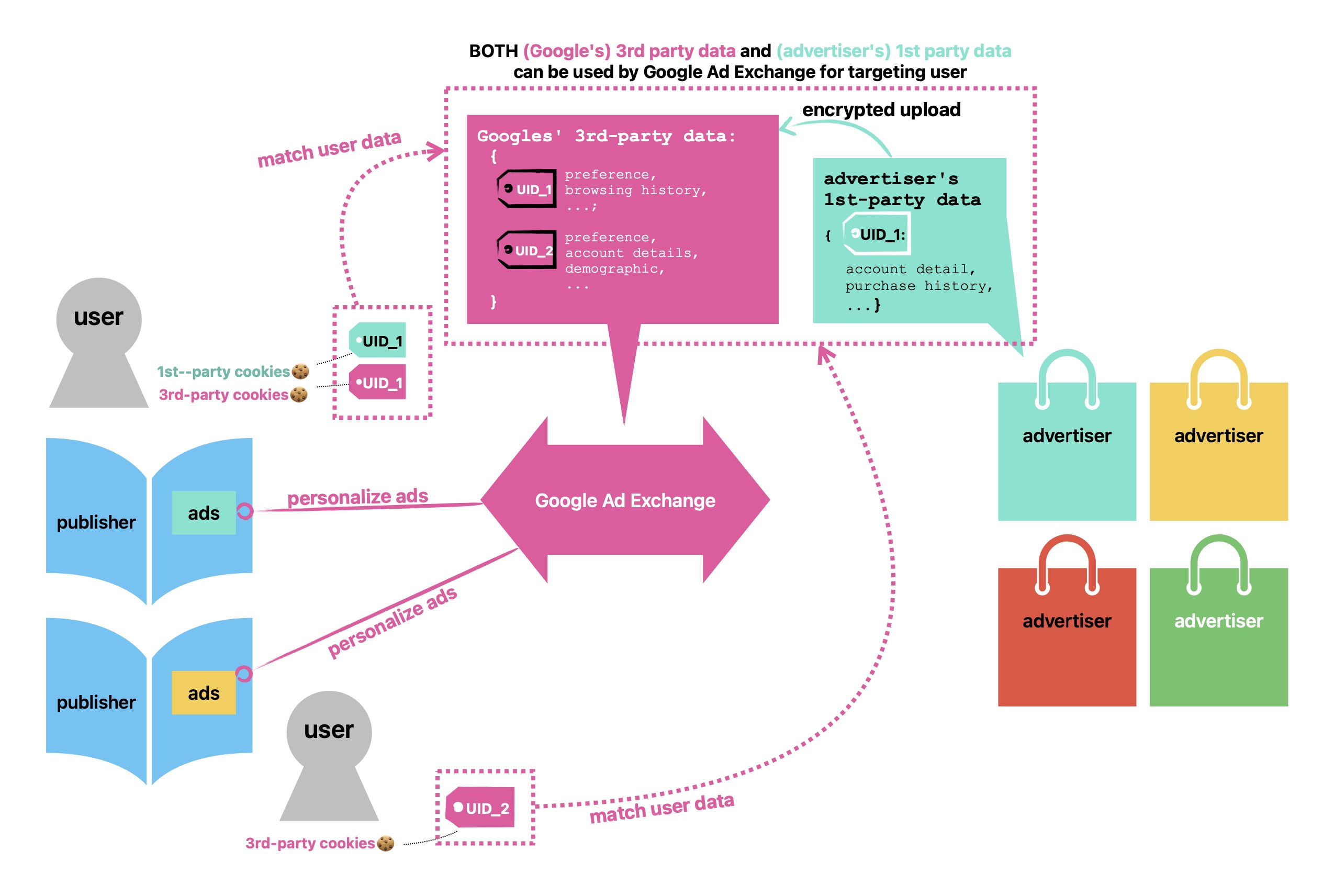
Consider a scenario where a user visits a publisher’s website to read an article. If the publisher has sold its ad-display space to Google, Google will then access the user’s 3rd-party cookies to retrieve the user’s UID (Unique Identifier). This allows Google to match the user with its online database, analyzing the user’s preferences and other data collected from previous website visits. Using this private information, Google can then align the user with advertisers who are targeting specific user segments. This segmentation, based on privacy data collected from third-party cookies, greatly enhances the value of the advertisement. ...
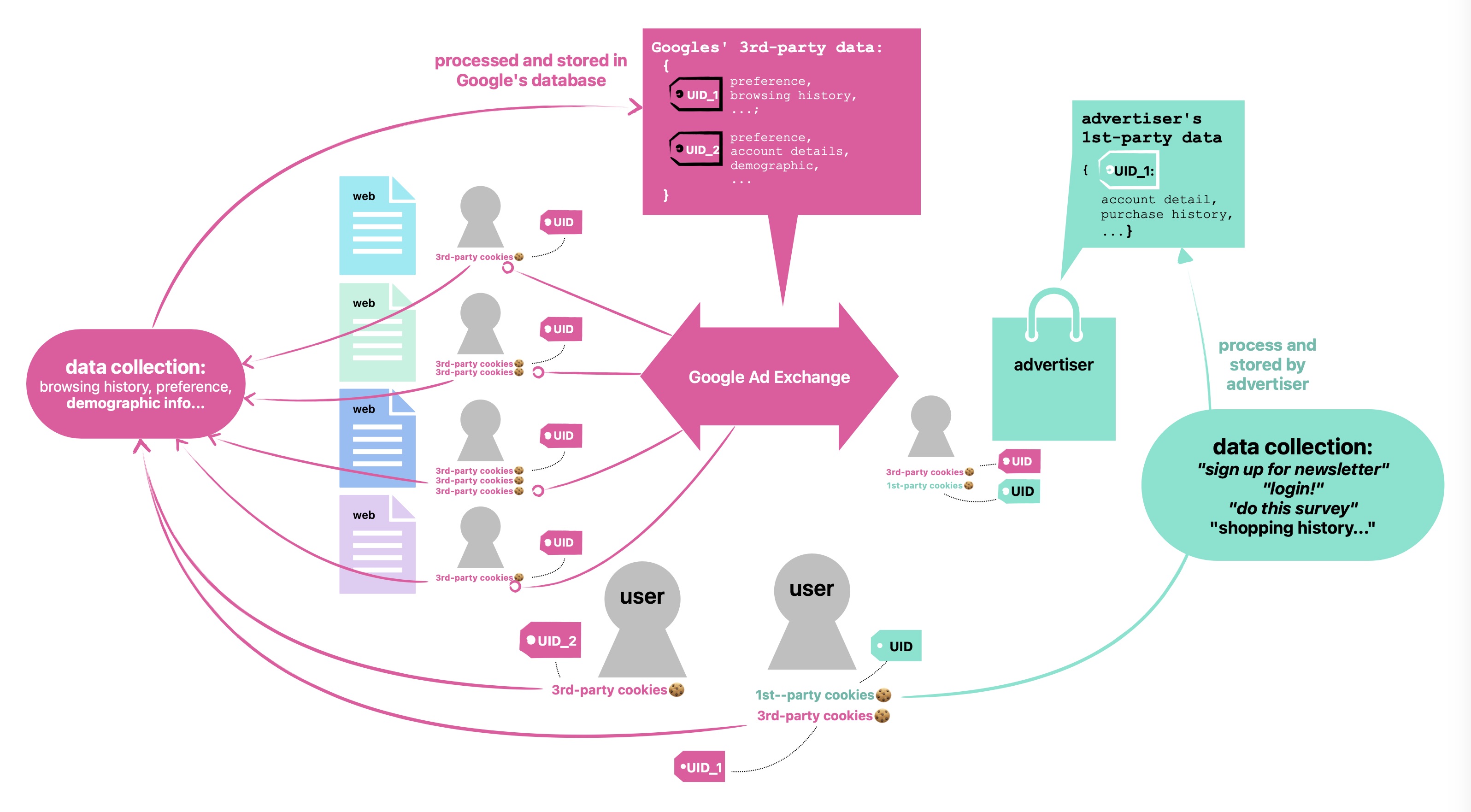
Cookies are small text files that hold a modest amount of data specific to a particular user and website. There are two types of cookies: First-Party Cookies. Stored and used by the same webserver entity: eg. NY Times stores user’s login info and language preference. Third-Party Cookies: The cookie is not being set by the news site directly (the first party), but by a separate entity (the third party). Third-party cookies are used by a third party to collect user information, while the user is browsing on the internet. The collected information is usually processed and stored by the third party for future usage, such as ad targeting, for selling the data. ...
Cookies are small text files that hold a modest amount of data specific to a particular user and website. It is stored locally on a user’s computer. The website specifies what data should be stored in the cookie, such as user ID, session keys, or preferences. I really like this example: Imagine a website is like a hotel. The hotel wants each returning guest to have their room personalized to their requests each time they visit. They have millions of guests so instead of keeping a list of what everyone likes in a huge book, they write the guests requests on their foreheads. That way, there is no confusion and there is no need to identify everyone in a huge database. When a guest returns, they instantly know what they want without even asking. ...
Market size and market share for adtech industry/online advertisement ecosystem The online advertising market is dominated by a few major players, with significant regional variations. The global online advertising industry continues to grow, at about $600 ~ $700 billion today, and showing no signs of slowing down [6]. Global market size of digital advertising. Source. The market is highly concentrated. Based on data in 2019, Google and Facebook (Meta) account for approximately half of the digital advertising global revenue [2]. ...
The AdTech ecosystem is rich, complex, and difficult to navigate. Demand-side platforms (DSPs), unless they are hidden behind another layer like Agency Trading Desks, act as intermediaries between advertisers and ad exchanges. They function similarly to the relationship between a stock exchange, consumers, and securities. DSPs depend heavily on third-party cookies. Through the process of cookie syncing, cookies and all privacy information are ultimately collected by DSPs. They use this data to segment consumers and sell these segments to advertisers, in addition to providing other services such as data management, analytic services, and insights. ...
Yes we’re talking about cookies. But before closely inpect our target Google, let’s take a step back for a higher-level view at the online advertisement industry to get a bigger picture—the AdTech ecosystem. The key of everything is programmatic advertising, and it is the main tool that distinguishes AdTech from MarTech (marketing technology). Programmatic advertising is the use of technology to buy and sell digital ads. Programmatic advertising uses an automated process to purchase digital ad inventory from across the web, mobile, apps, video, and social media. Programmatic advertising uses workflow automation and machine learning algorithms to deliver the most effective ads to audiences based on a variety of signals, like demographics, shopping patterns, and more. ...
Cookies, small text files stored on a user’s local computer, are pivotal in carrying information across the internet. This is because the HTTP protocol (the way we communicate with the web) does not retain information between sessions. To store and retrieve any information—even something as simple as what was entered before and after clicking the ‘search’ button—we and the web need cookies. This mechanism makes our browsing experience seamlessly smooth. ...
Optimizing Product Launches in the Presence of Strategic Consumers. By Ilan Lobel, Jigar Patel, Gustavo Vulcano, and Jiawei Zhang. Management Science 2016. DOI https://doi.org/10.1287/mnsc.2015.2189 The paper studies firm’s product launch policy. It is motivated by the industry example, where tech firms iteratively release new models of their products. For example, Apple releasing one new iPhone models almost every 12-18 months, or Nintendo’s upcoming switch 2 that has been overdued 7 years (still is though). ...

Henri Biva. French artist, active around 1900s±, somewhere between post-impressionism and realism. This painting is one of Henri’s masterpieces that showcased the artist’s mastery in capturing warm natural light. Etang dans la brume (aka Pond in the mist), Henri Biva (1848 – 1929). Salon de Paris, 1910. Oil on canvcs (151cm•111cm). Now in Musée d’Orsa. ...