a study of the lowercase aesthetic

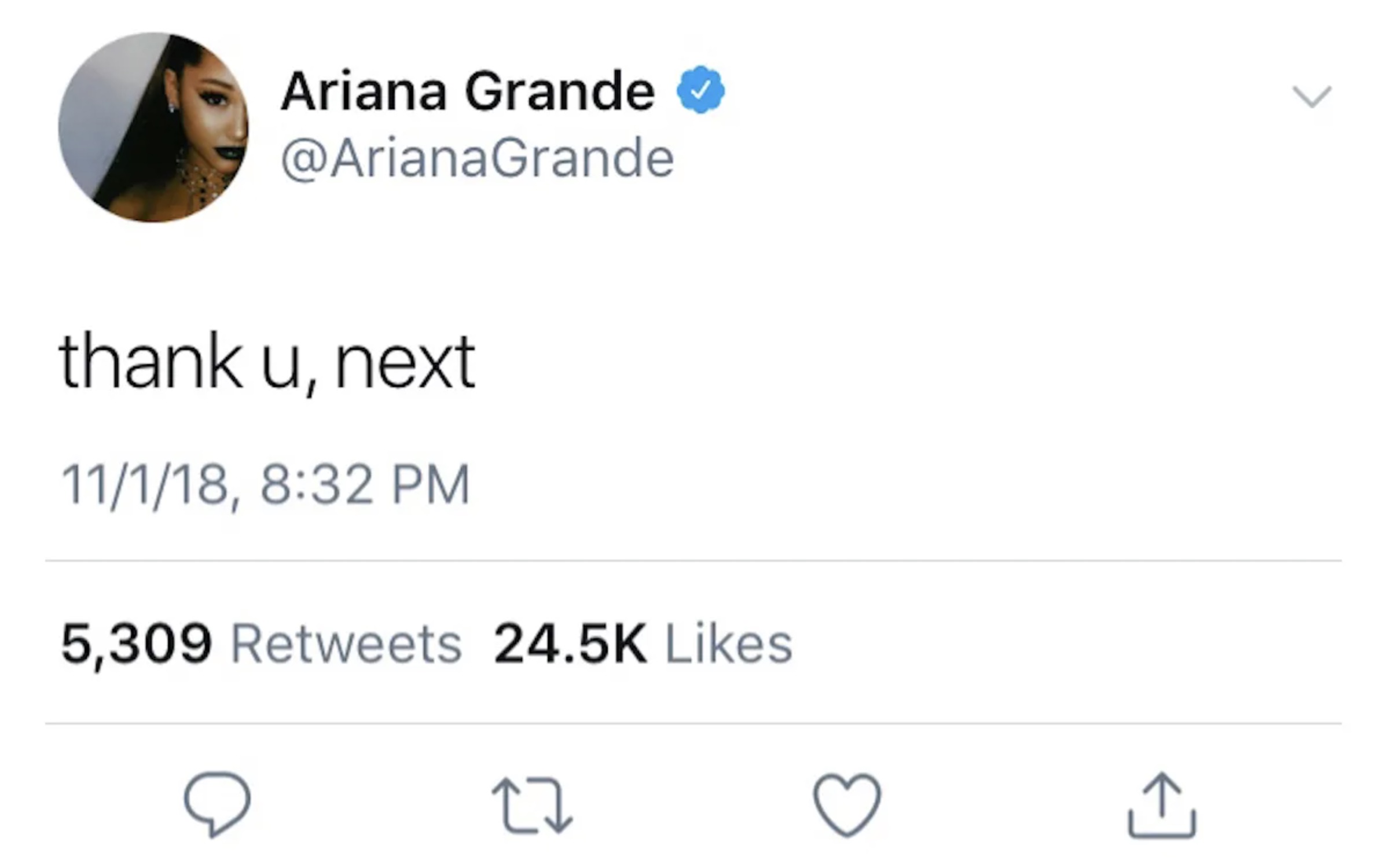
I prefer writing in all lowercases–especially devoid of conventional capitalizations of the first letters. First learnt this in Ariana Grande’s Sweetener album tracks’ all-lowercase namings and initially trying just for fun, I found this way of styled writing extremely comfortable so that it eventually forms into a habit. This seemingly personal preference however, coincides with a latest trend of writing style, especially among Gen Z. Ariana Grande’s iconic, abusive use of all-lowercase writings in her social media posts, do do her fans. Mariah Carey though (see her reply in the lower left corner), still uses the gramatically correct way of typing, even on Instagram. ...

February 19, 2024

tags

categorized and re-organized list of tags. hurray to my OCD…

February 18, 2024

the first amendment | ariana's blog

what to look forward

February 17, 2024

catch me if you can, starring generative AI

Make the AI dance in certain ways, they would eventually stumble. Here’s a new story from the economist about fake-news new: Many AI researchers think fakes will become undetectable AI created contents that are indetectably mixed within genuine ’natural’ human products are causing a lot of troubles. Deep-fake videos and news are generating misleading information towards public. For AI developers who relies on internet-based text corpus to train new AI versions, they are finding their relied sources being polluted by AI generations. Hence, how to detect such trickery is a live topic among ai researchers. There are two primary ways of detection: some firms offer software that aims to spot machine-generated media; others, like the makers of big ai models, meanwhile, are searching for ways of “watermarking” their output so that real pictures, video or text can be readily distinguished from the machine-generated sort. ...

February 16, 2024

bots, bucks and blockbusters

The Spring Festival in-cinema movie market is a compelling subject for analysis. From a macro perspective, its structure transcends the basic two-sided model of buyers and sellers. This market encompasses multiple stakeholders: cinemas, filmmakers (including actors and directors) and their production companies, ticketing platforms, rating agencies, social media, and, crucially, the consumers themselves. These Spring-Festical films are typically produced months in advance, with release dates often aligned with the Spring Festival holidays. They are usually family-friendly comedies, are specifically designed for holiday viewing and might not hold the same appeal outside this context. This creates a marketplace with diverse goods (of small variance), almost invariable supply, and flexible pricing mechanisms—ticket prices can fluctuate, and cinemas have the autonomy to schedule screenings. ...

February 15, 2024

bonus for valentine's day

With Valentine’s Day colliding with the fifth day of the Spring Festival, love is in the air, and economics is on the mind. Here are two tales where romance meets rationality. The Economist’s cost-of-loving index Love, they say, is priceless. But let’s face it, showing off one’s financial prowess can be quite the love language in today’s material world. Valentine’s Day, in particular, turns into a veritable showcase of affection-measured-in-dollars. According to the National Retail Federation, the average American is expected to shell out $186 to woo their Valentine this year. ...

February 14, 2024

selling information - model and bound

A paper I read recently is somewhat interesting. The model is very inspiring for an OM project I’m working on recently, whereas its mathematical method and results are immensely useful to learn from for another problem that I’ve been working on for a while. Is Selling Complete Information (Approximately) Optimal? Dirk Bergemann, Yang Cai, Grigoris Velegkas, and Mingfei Zhao. 2022. ABSTRACT We study the problem of selling information to a data-buyer who faces a decision problem under uncertainty. We consider the classic Bayesian decision-theoretic model pioneered by Blackwell. Initially, the data buyer has only partial information about the payoff-relevant state of the world. A data seller offers additional information about the state of the world. The information is revealed through signaling schemes, also referred to as experiments. In the single-agent setting, any mechanism can be represented as a menu of experiments. A recent paper by Bergemann et al.[8] present a complete characterization of the revenue-optimal mechanism in a binary state and binary action environment. By contrast, no characterization is known for the case with more actions. In this paper, we consider more general environments and study arguably the simplest mechanism, which only sells the fully informative experiment. In the environment with binary state and m≥3 actions, we provide an $O(m)$-approximation to the optimal revenue by selling only the fully informative experiment and show that the approximation ratio is tight up to an absolute constant factor. An important corollary of our lower bound is that the size of the optimal menu must grow at least linearly in the number of available actions, so no universal upper bound exists for the size of the optimal menu in the general single-dimensional setting. We also provide a sufficient condition under which selling only the fully informative experiment achieves the optimal revenue. ...

February 13, 2024

the market power of higher education

Today’s blog draws inspiration from Michael D. Smith’s perspective on higher education, as discussed in a recent episode of the podcast People I (Mostly) Admire, titled “Higher Education Is Broken. Can It Be Fixed?” . Btw, the podcast itself is part of the Freakonomics network, the academically inclined perspective is particularly sweetspot for an econ student. This episode elucidates the systemic flaws plaguing the U.S. higher education system. One pov involves diving into the market power of colleges. ...

February 12, 2024

navigating the future of data trading

I’m reading some papers about mechanism design on pricing of information, following up on this data trading reading session Bergemann et al. (AER 2018): The Design and Price of Information. Bergemann et al. (EC 2022): Is Selling Completely Information (Approximately) Optimal? Bergemann et al. (EC 2015): Selling Cookies. Hopefully, I’ll finish them within this week. I have a strong feeling that they will be immensely interesting. Before our discussion, a short notice: a review of numerous news posts and literature in econ-CS reveals a significant discrepancy between academic research on data trading in algorithmic game theory (AGT) and Econ-CS communities, and the evolving realities of the actual data trading market. It’s possible that there exists another body of literature I’m yet to discover; however, the current economic literature, particularly on information design, lacks a clear outline of a real-world data trading market. Moreover, with the rise of generative AI, the valuation of data, such as labeled data coveted by tech giants for exclusivity, needs reevaluation to align with AI training standards. ...

February 11, 2024

from the Economist | Data is giving rise to a new economy

I’ve been researching on data trading. China established several state-owned data exchange centers (e.g. Shanghai Data Exchange) and they are gradually building momentum recently because of the generative-AI booming bubble. But it’s not a new thing. An early article ‘Data is giving rise to a new economy’ sort of predicted the prosperous market seven years ago (The Economist, May 6th 2017). Data are to this century what oil was to the last one: a driver of growth and change. Flows of data have created new infrastructure, new businesses, new monopolies, new politics and—crucially—new economics. Digital information is unlike any previous resource; it is extracted, refined, valued, bought and sold in different ways. ...

February 10, 2024